Showing posts with label Lynda. Show all posts

Thursday, October 18, 2018

Aztec Soul Coconut Macaroons #choctoberfest

7 comments:

I was provided with Forte Chocolate for this sponsored post as a part of #Choctoberfest.  
All opinions, photos and recipe are unsolicited and are my own.

I have one more recipe to share with you using the Forte Artisan Chocolates I was provide to use in this week's #Choctoberfest celebration!

This time, I wanted to share something sweet - macaroons!  I decided to dip them into melted Aztec Soul chiles and dark chocolate to give them a hint of spiciness to go with the richness of the macaroons.

The Aztec Soul bar is very creamy, high quality chocolate and while the chile spice is there, it is not overpowering. Chiles and chocolate just go together like, well... chiles and chocolate!

These macaroons are pretty quick to make, just a little bit messy, and take some space in the freezer for a flat cookie sheet in order to set after dipping in the chocolate.  They store well in the refrigerator or freezer for quick serving, if you can keep them around long enough to need storing.

Aztec Soul Coconut Macaroons
Makes about 36 macaroons

2/3 cup sweetened condensed milk
1 egg white
1 tsp vanilla extract
1/2 tsp orange extract (or more vanilla)
1/4 tsp. salt
3 1/2 cups unsweetened shredded coconut
2 bars Forte Aztec Soul bars (approx. 3.16oz total)

Preheat oven to 325F, and prepare a cookie sheet by covering it in parchment paper.

Combine sweetened condensed milk, egg white, extract and salt in a large bowl, and whisk to combine. Add coconut and stir until thoroughly coated.

Using hands, a small ice cream scoop or two spoons to make balls (about 1" in diameter), and set on parchment covered cookie sheet, making sure they don't touch one another. (You'll need to do this in two batches)

Bake 15 minutes, or until lightly golden.  

Cool on baking sheet for a couple of minutes, then transfer to a wire rack to cool completely.

Repeat with the second batch.

When macaroons are completely cooled, melt chocolate in a microwave safe bowl for a few minutes until melted. Whisk to ensure complete melting.

Re-prepare a baking sheet with parchment paper.

Dip the flat bottom on the macaroons into the melted chocolate and set on the parchment, chocolate side down (try not to move once you've set one down).  Continue until all macaroons have been dipped and placed.

Put baking sheet into the freezer, setting it flat, for at least 15 minutes, until the chocolate is firmed up and set.

Store macaroons in an airtight container in the refrigerator or freezer.


Forte has a Buy 3, Get 1 Free offer on their website - just use the code CHOCTOBERFEST2018 when you check out!

Follow Forte Chocolates on social media for more promotions and great ideas for enjoying unique and delicious chocolates: 


Also, don't forget to enter the Choctoberfest Giveaway this week to win a huge prize that includes an Instant Pot, cake decorating equipment and goodies from Forte as well as the rest of our sponsors!


Check out what other bloggers are sharing today for Choctoberfest:


Thursday, September 27, 2018

Simple Sauerkraut Inspired by #cookthebooksclub Selection "Sourdough"

16 comments:


The August/September Cook the Books Club reading selection was "Sourdough" by Robin Sloan, and as usual, I am squeaking in at the very end.

I actually read the book about three months ago - based on the name, I pictured this might be a cozy little novel about some wholesome baker experiencing the joys of breadbaking.  Well, it was...and wasn't and I'm not sure it can really be put into any sort of genre box.

It has strong magical realism elements, a bit of Old Country fable, a lot of Silicon Valley weirdness of both the high-tech variety and the obsessive foodie variety.  There are robots.  There's a whiff of Little Shop of Horrors. It's fun in parts, strange in others, and I'm not sure the story ever really pulled itself together in any cohesive way.

I'm not sure I'm exactly recommending it, but I'm not warning anyone away either - it was an easy read and if it was a bit frothy, it wasn't unpleasant froth.

The key character is a woman who is very good at programming robotic arms, but isn't particularly enjoying the work.  She, like many of her colleagues, subsists on some nutrient ooze that comes in squeeze packs, along with the occasional soup and sourdough from an underground food delivery service near her apartment.  When the brothers that deliver for her leave the country, they leave her with their sourdough starter, a wonderful batch that has come down to them from their ancestors for generations.

This is where it gets weird - the starter, like all starters, is alive, but this one is really, really alive.  It occasionally glows with life, it responds to music, it has moods.  The main character learns the care and feeding of it and learns to bake bread, eventually connecting with an exclusive experimental food market where high tech and fermentation come together to create innovative foodstuffs, from her sourdough bread (made by robotic arm) to cheeses to 'lembas' - a fermented mass intended to end world hunger.

Fermentation and the art and science of working with living organisms is the wider theme here. Just as humans come together in communities that have their own dynamics, micro-organisms create communities that transform themselves in living, interacting and dying into something amazing.

I knew I wouldn't be making sourdough for this - I am the Sourdough Starter Murderer, and had no interest in destroying yet another micro-galaxy in trying again.

Then I tried and failed to make some apple cider vinegar - it got away from me due to my own neglect and I created mold. Yay, me! (Fementables getting away from you and doing their own thing is definitely an aspect of the novel.)

So I fell back on the one fermentable I know I can do - homemade sauerkraut.  This is it at its simplest - cabbage and salt.  I find it pretty foolproof. I like to use purple cabbage for its color and while many variations can be had by adding spices or other vegetables, this simple version is an easy and relatively foolproof introduction to fermenting.

This is a really simple way of getting some fermented veggies on hand, and it takes so much more delicious than store-bought kraut.

I think the big key to the process is using Fido jars.  I have a couple Bormioli Rocco blue lidded jars that I just love - they have a great solid seal, and the blue glass lid is so pretty.  The thing about Fido jars is that they let excess pressure leak out, but they let no oxygen in - no oxygen means no molding.

I like not having to worry about things like that.  The other thing that ensures it, of course, is making sure your containers, utensils and work surface are all clean and sanitary.   So, with that out of the way, here's all it takes:


Purple Sauerkraut

Ingredients

  • 1 head green cabbage
  • 1 head red cabbage
  • 4 T. salt

Equipment

  • Cutting board
  • Large sharp knife
  • Large mixing bowl
  • Food processor
  • Potato masher 
  • Large serving spoon 
  • Fido jar (50oz or larger)

Instructions

  1. Wash and dry your cabbage, removing any worn outer leaves.  Cut the cabbage into chunks, removing the cores.  Feed the chunks through your food processor set to grate coarsely.  As processor gets full, turn the grated cabbage into the large mixing bowl, and sprinkle with some of the salt.  Continue to process and salt the cabbage until done.
  2. Cover the bowl loosely and let it sit about 1/2 hour - the salt will start releasing liquid from the cabbage.  Using a potato masher, pound the cabbage for a couple minutes to more completely release the liquid.
  3. Scoop cabbage into Fido jar, mashing it down as you go to fit more cabbage.  Make sure all liquid from the bowl ends up in the jar - the cabbage should be covered with liquid.

  4. Seal the jar and set it aside in a dark place with a moderate temperature (70-80F) for 4-6 weeks, then refrigerate.

Here's the full round up of Sourdough inspired posts!

The Cook the Books Club selection for October/November is Michael J. Twitty's "The Cooking Gene: A Journey Through African American Culinary History in the Old South."  If you haven't read it yet, I highly recommend it!

Wednesday, May 2, 2018

Stacked Enchiladas with Fried Egg #FoodieExtravaganza #CrazyforChiles

10 comments:


This month's #FoodieExtravanza, hosted by Camilla at Culinary Adventures with Camilla, was super exciting for me in a couple of ways.  First, the challenge dish is ENCHILADAS which guarantees I'm going to love every single variation in the link up (below).  But, secondly - Camilla set several of us up to receive some complimentary Don Enrique brand dried chiles from Melissa's Produce, an online fresh produce store that ships a good part of their stock US wide.

It was wonderful to have the opportunity to experiment - the sent assortment included several types of chiles, including some scary hot Carolina Reapers, but for my enchilada dish I decided to stick to flavorful and smoky rather than crazy hot, while using a few varieties to give the sauce some depth.


Armed with a pair of gloves to protect my skin and face while handling the chiles, this is what I came up with for my enchilada sauce.  Should you want a hotter sauce, simply switch out some of the chiles for hotter varieties:

Smoky Enchilada Sauce
(makes approx. 4 cups - you can halve the recipe as desired)


8 dried guajillo chiles (moderate, smoky, sweet)
8 dried ancho chiles (dried poblanos, mild, smoky)
2 dried pasilla negro chiles (mild, earthy, fruity)
1-2 dried oaxaca chiles (mild, smoky)
1 T. oregano, dried
1 T. cilantro, dried
2 T. ground cumin,
2 squares dark chocolate, minced (I used Ritter Sport Dark Chocolate w/Espresso)
hot water

To prepare the chiles:
Cut off stems, slit open chile and remove seeds. (I found kitchen shears to be the easiest way of doing this, scooping out the dried seeds with a gloved finger)

Heat oven to 400F.  Cover a cookie sheet with parchment paper, lay out the dried chiles in a single layer, and toast for 3 minutes, until fragrant but not burned. (It won't take longer than that!)

In a large bowl, put the toasted chiles and cover with hot water, weighting them down with a plate to keep submerged.  Set aside for about an hour until they are softened.

Into a blender or food process, combine the chiles, 2 cups of the water used to soak the chiles and 2 cups fresh hot water, along with the remaining ingredients. Puree until very smooth (it may take a couple tries to completely puree the chile skins).

Before using, make sure you all the sauce to simmer for awhile - it will finish off the flavors.

Store in the refrigerator for up to a week, or freeze for later use.


That was the hard part!  Making these stacked enchiladas is easy - MUCH easier than making a rolled up casserole.  It does take several pans, though, and a short order cook style of quick preparation, but you'll have dinner on the table in a flash, especially if you can enlist  the help of others present to help with the steps.

The word 'enchilada' describes the key factor that makes for an enchilada (or enchilada sauce) - it means 'covered in chiles' and, according to Rick Bayless, a person might be called 'enchilada' (or 'enchilado') to explain that state where you've eaten something full of chiles and are desperately seeking something cooling to sooth the burning!

An enchilada is a tortilla covered in chile sauce - after that, everything else is optional.

The very easiest version I've made is meatless - just corn tortillas, diced raw onion, and sauce.  With that platform, add whatever suits you - seasoned meat, beans, cheese, vegetables, olives, sour cream....  The possibilities are endless!


One traditional version tops the works with a fried egg, one of my favorite ways to enjoy these.

Stacked Enchiladas with Fried Egg
per serving:
3-4 corn tortillas
cooked crumbled Mexican chorizo
enchilada sauce, simmered
oil, heated in pan as for deep frying (I used coconut oil)
diced onion
sliced black olives
1 egg, sunny side up

Using tongs, cook a tortilla in the hot oil for a minute or so (it should still be pliable), then dip in the simmering enchilada sauce to cover.  Place on a plate, add a thin layer toppings as desired.

Repeat this process, using 3-4 tortillas and layering toppings, ending with a layer of toppings, and then a fried egg.  The runny yolk will break over the rest of the toppings, creating a rich and very satisfying finish for this simple dish.


This is comfort food that is sure to make you smile!  Check out how others are making their enchiladas:


Monday, January 22, 2018

Feast of Sorrow: Whole30 Chicken Apicius #cookthebooks

16 comments:

Every couple of months, a few bloggers get together for the Cook the Books Club to read a book, and make a dish inspired by it. The book for Dec-Jan. was Feast of Sorrow, by Crystal King.

I'd never read this before, but I happily tucked a copy of it into my Kindle just before we took a two week vacation to Germany, and I found it very compelling.

The book is a novel set across a span of years in the household of Apicius, a wealthy epicurean whose obsession is food prepared in the most interesting an exotic ways possible. The story centers on Thracius, a slave Apicius purchases because he has a reputation for being a highly skilled cook. Over time, the two work together to write a series of recipes - a cookbook - that would come to us today as one of the most comprehensive explanations of an ancient culture's foods we have available.

Apicius is portrayed as temperamental and inconsistent, by turns punitive and friendly to his closest slaves, and Thracius is portrayed as the voice of reason and the skill and brains behind the lavish meals that are bringing Apicius renown while he tries to hold the household together in the midst of external and internal intrigue.

Familial and political crises abound, and the result is a book that is both very compelling and highly disturbing, ending on a dark (but historically accurate) note.

While it is fictionalized (there is no Thracius mentioned in the annals of history), there are a lot of details 'ripped from the headlines' of the Roman Empire.

Apicius likely did exist, although it is also likely that over time his name was used by other epicureans to lend credence to their own recipes.  The surrounding characters and many of the events are historical.

Reading it while traveling through Germany, including to the Roman city of Trier (my friend and co-writer Lauren recently shared her own trip to Trier here) really helped me feel a sense of place about the story.

The food inspiration runs all through the book - too much to keep up with, actually!  Each chapter begins with one of Apicius' recipes.  I tried to keep notes and found my Kindle copy was chock full of highlights and notes.

When we returned home, I put together a few ideas, planning to create a Roman 'feast' for our New Year's Eve meal... and then we decided to go to Florida for a couple weeks for the holidays and there was simply no time to shop or plan for that feast, so I went back to the drawing board.

I had a half thought out idea for some sort of cute 'dormice' thing made out of chocolate - but then we started a month of Whole30.

WHAAAAT??? CAN YOU EVEN ROMAN ON THE WHOLE30?????

The definitive answer is: Not happily!  Apicius would have been shocked and appalled.  The Stoics would have been horrified.

Roman cuisine relied heavily on grains, wine, dairy and honey - all disallowed on Whole30. Meat was a luxury food - so Apicius enjoyed it frequently, but for most Romans the only meat they had came from the shared meat made available at civil sacrifices.

Vegetables were used as they could be had - but that meant only what was available locally and in season.

So what to do?  I grazed everything I could find about Apicius, his recipes, modern interpretations of his recipes and there was just very little to work with that felt inspirational.

There were a few things I knew I could include - dates, figs, olives, olive oil, fish sauce.

So - because I really needed to sort out my menu plan, I decided to lean hard on the 'inspired by' portion of this challenge, and started with Chicken Marbella, a Silver Palate faux-Spanish recipe born in the 1970s.

First, I had to make it Whole30 compliant, and then I had to make it 'Roman'.

(By the way, faux-foods would have totally appealed to Crystal King's Apicius, I think!  So a faux-Spanish recipe going faux-Roman? Served with faux-pasta?  On it!)

My modifications involved switching the wine for wine vinegar, getting rid of the brown sugar entirely, and switching out the prunes for dried dates (why? Because I have dates in the house, love them, and dates and figs feel more Roman to me).

Finally, in an homage to the never-ending fish sauce, which seemed to go into everything, I added a bit of Red Boat fish sauce, too.

The result was quick, easy and delicious!

My husband and I agreed that this was going straight onto regular menu rotation (with wine and some honey once I can cook with those again).

Even without the wine, the vinegars mellowed, and the flavor was really intriguing and delicious.

Chicken Apicius (Whole30)
(serves 4)

3-4 cloves garlic, finely minced
1/3 cup olive oil
1/3 cup balsamic vinegar
1/3 cup red wine vinegar
1 Tblsp. Red Boat fish sauce
1 cup dried dates, pitted
1/2 cup green olives, pitted
1/3 cup capers
3 bay leaves
1 Tblsp dried oregano
Salt and pepper to taste
8 boneless, skinless chicken thighs
1-2 zucchinis
olive oil

Combine all but the chicken in a baking dish, mixing well to combine.

Nestle the chicken into the pan, among the olives and prunes, flipping a couple times to coat with the sauce.

At this point, if desired, cover and put the pan into the refrigerator to marinate for awhile.

When ready to cook, preheat the over to 350F and bake for 25-30 minutes.

While the chicken is cooking, spiralize one or two zucchinis (or use store-bought spiralized zucchini, which is a thing now!), and saute for about 4-5 minutes in a pan along with a bit of olive oil or ghee and season to taste.

When the chicken is done, remove the chicken, olives and dates from the pan and serve along with the zucchini noodles.

This is where this really veers from the Silver Palate version - that recipe calls for wine and brown sugar to be added to the vinegar sauce in the pan and thickened into a sauce to be poured over the chicken. Which sounds awesome, but also impossible to modify for Whole30 and honestly, the chicken did not notice the lack at all.

Either way, this meal was a winner!

cookthebooks

At the end of the month, the full round up of #cookthebooks Feast of Sorrow posts will be compiled by Debra of Eliot's Eats. I can't wait to see what others have done!


Thursday, May 25, 2017

Mom's Almond Puff Danish #CooktheBooksClub

29 comments:

I am participating in the Cook the Books Club, where bloggers collectively read a book that is food based in some manner, and then prepare a dish inspired by the book.

The April/May book selection was Life From Scratch: A Memoir of Food, Family and Forgiveness, by Sasha Martin.  The invitation for this round's challenge,hosted by Eliot's Eats is here.

Sasha Martin is also the blogger behind the extensive blog Global Table Adventure, a truly fascinating collection of essays and recipes from around the world.  Sasha, her husband and her young daughter took on a project to eat a meal from every country, and learning not only about food and other places (and in the case of her husband, working to overcome a lot of food pickiness), but about themselves as well.

The result was Life from Scratch - initially intended to tell the story of the project, it instead lead Sasha to turn toward her own childhood and past, as she realized that for her, cooking had always been a connection to otherwise very difficult relationships, as well as a solace through periods of life that were painful and often harsh.

Through it all is her uneasy connection with her mother, who seems to be a free spirited artistic woman who, due to both circumstance and temperament, was not well suited to be a mother.

At times, this memoir was very painful to read, but I appreciated  the ambivalence that didn't attempt to make her mother's choices sound better than they were, or to write her off as merely the villain of the story. Others in her life are also depicted fairly - the pain they caused is described, but through her words, those that might be offered compassion are granted it.

Primarily, it is a story set in the real world of very flawed human beings often making very poor and selfish choices - and this makes it both an uncomfortable read as well as a compelling one.

Through it all are a few recipes, but I'd recommend visiting the website if your main interest is food (and do visit - it is sure to cost a few hours of riveting browsing) and read the book if you like memoir.

One of the more evocative passages had to do with her mother's specialty dessert, German Tree Cake (Baumtorten).  This led me to think about my own mother's culinary signature recipes for my own inspiration.

My mother was a woman I admire greatly as a person, but our relationship as mother and daughter was complex and difficult, and ultimately unresolved as she passed away last year after a long decline due to Alzheimers.  For this reason one of the things that spoke to me about Life From Scratch is the relationship that developed between mother and daughter later in the mother's life.

By the standards of her era (and I sometimes think we children soaked up our ideas of 'right' parenting mainly from idealized fiction), she was not very domestic at all all, and that was regarded as a failing regardless of whatever else she did.

My mother's way of navigating expectations was to perfect a few signature recipes for necessary occasions - a couple terrific entrees for dinner guests, as well as a side or two for holiday feasts we shared with other families.  She even learned to make bread and butter pickles and happily passed out jars to others as needed.

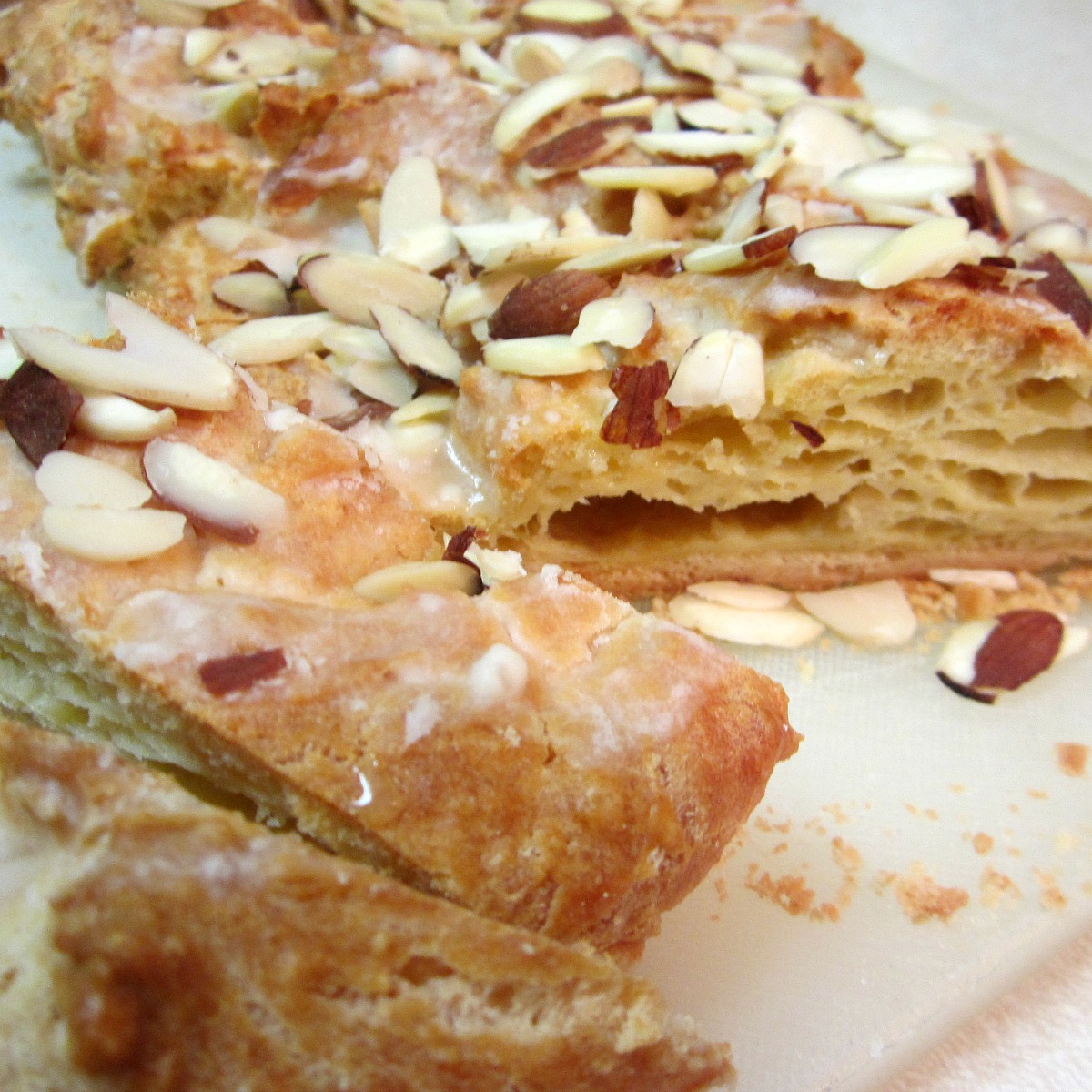
But her main signature recipe was this Almond Puff Danish - this went to potlucks, office gatherings, tea parties and bake sales.  If she'd even wanted to try something new (and she rarely did), people asked for this - it was her recipe, her thing.

I suspect it was also half the country's thing, because the recipe itself came from a set of Better Homes & Gardens subscription cards.  Anyone remember those? Each month, you'd get a packet of about 24 cards on a given theme, to be collected in a special, deep recipe box big enough for the whole set.  I think mom only ever used 3-4 of those recipes, but this one she made her own.

Mom's Almond Puff Danish

makes approx 16 slices
Preheat oven to 350F.

Bottom Layer:
1/2 cup butter, softened
1 cup flour
2 Tblsp. water

Top Layer:
1/2 cup butter
1 cup water
1 cup flour
1 tsp. almond extract
3 eggs

Glaze:
1 cup powered sugar
2 Tblsp. butter, softened
1/2 tsp. almond extract
1 Tblsp. milk
sliced almonds

Prepare bottom layer:
Combine flour and butter in a large bowl, and cut together with a pair of table knives or a pastry cutter, until it is grainy and well combined.

Sprinkle with water, and work with hands to form a dough (don't overwork).

Divide dough in half and shape into to rectangles on an ungreased cookie sheet. Pat down so that each rectangle is about 1/5" thick.  These needn't be shaped perfectly, but should be about the same thickness for even baking.   Set pan aside.

Prepare Top Layer:
In a medium saucepan, combine water and butter and bring to a boil, stirring to melt the butter.  Remove from heat, add extract, and then add flour all at once.  Stir vigorously until dough leaves the pot's sides, forming a ball (should take about a minute).  Add eggs all at once, and continue beating until eggs are incorporated and dough is smooth.

Pile topping on each triangle, spreading to cover.  It will be thick and high, and if you leave soft peaks in, the texture will be more interesting once baked.

Bake for one hour at 350F.  Cool completely on a wire rack on pan.


Glaze:
Cream softened butter, powdered sugar and almond extract thoroughly. Add water a bit at a time until desired thinness is achieved.  I prefer mine on the thinner side, but this can be made thicker if you like.

Remove pastries from pan and set directly on wire rack (they should be firm enough to move as long as you're careful).

Place rack on top of the pan.

Spoon glaze over the top - excess will drizzle through the rack to the pan.

Sprinkle with almonds, and pat down lightly.  Let sit about a half hour, until all glaze is set.

Slice into long bars and enjoy!


cookthebooks


Head over to Eliot's Eats to see the entire round up and see how other bloggers were inspired by Life from Scratch here!

Wednesday, April 26, 2017

A Touch of Spice: Beef Kebabs #FoodNFlix

29 comments:

I decided to join the Food n' Flix Club, where monthly, bloggers watch a selected movie and then cook something inspired by it.  This month's host is Culinary Envy (the invitation is here and the full round up is here) and she chose a Greek movie called A Touch of Spice.

I'd not only never seen this movie which was released in 2003, I'd never heard of it.  But they had me at "Greek", and since I was unable to find it at our library or for streaming, I went ahead and bought it.  I was a little intimidated -this is is subtitled, which I often find challenging.

But I actually forgot that I wasn't understanding the spoken language and the words and imagery were so lyrically beautiful, I found it easy to stay engaged.

In fact, I'm not sure I've ever been so frustrated to discover that a movie was not based on a book, because it seemed as if it should be (preferably one with a few recipes tossed in).

The composition is set up like chapters in a cookbook,  and the pacing and flow of the story is complex and well structured, with frequent flashbacks and thematic repetitions.

A Touch of Spice tackles the impact of being a child of Greek and Turkish heritage in early 1960s Constantinople, during a period of political conflict where Greeks in Turkey were forcibly deported to Athens.

Food is everything to this story - it is memory, solace, an expression of pain and of will, and it is the glue that holds together one's personal and cultural identity when home is no longer home, and the very definition of home is redefined by nationalism and politics.

Mostly, though, food is love - the love between a boy and his grandfather, and between the boy and the girl he knew as a child.

It is the love between his parents, who carry on an ongoing bit of lighthearted bickering as they tie together food and their memories of historic moments they've shared, and the aunts and uncles who cook, eat and share memories together.

It is the love for all those who would share your table, and those who are never able  to, and finally - and especially - love for oneself and the acceptance of who you are whether or not those who love you understand you. And of course, it is the love of food itself, and the process of preparing it.

It's a lot to unpack, yes?  This is why I so much wish this were a novel.  Even so, I managed to catch and savor a few delicious passages while keeping notes.

There were so many bits I love, from the umbrella that appears in so many scenes, to the explanation that men go to steambaths to discuss difficult things with each other because, there, they can open their souls, like steamed mussels.

The movie is divided into three parts, each with explanations of that portion's theme. I'm going to leave the plot details out of this because I recommend watching it!

Appetizers - "Appetizers tell of faraway places and prepare you for an adventurous journey." 
The Main Course - "Main Courses take us back to childhood."
Dessert  - "...the desserts are the epilogue of every fairy tale."

The movie carries not just a touch of spice and a beautiful look at a period of history seen through a love of food and family, but also a good dash of humor; I recommend it highly.  There is even a pinch of magical realism, where cinnamon, used at the right, or wrong, moment can make a person look you in the eyes and truly see you, and where spices hold correspondences to the dance of the universe.

I expect to watch this again and again, each time uncovering new tastes of all the many layers this movie has to offer.

So now - what did I decide to cook?  I wanted to make a hybrid meal to reflect the variations as well as the shared foods of these two cultures.

We are very lucky to have a great little Greek restaurant less than a block away - so we picked up some Rice Pilaf, Pita Bread, and an order of Greek Village Salad as sides, and I made some beef kebabs with a spice-rich marinade to go along with it - Greeks would make souvlaki, although generally with chicken, pork or lamb.


I don't claim anything authentic about the marinade - I've made kebabs for years in a doubtless American fashion. But I did select several of the spices because they were a key metaphor in the movie, or because they reflect the Turkish and Greek cultures.

Touch of Spice Beef Kebabs
(serves 4-6)

Marinade:
1/2 cup olive oil
2 Tblsp balsamic vinegar
2 Tblsp lemon
1 tsp ground black pepper
1 tsp ground cumin
1 tsp sea salt
1/2 tsp ground cinnamon
1/2 tsp ground coriander
1/4 tsp ancho chile powder

1.5 lb beef steak, cut into 3/4" cubes
onion or pearl onions
zucchini
pint cherry tomatoes
button mushrooms
bell pepper (assortment of colors if desired)

Greek yogurt

*Note: I can't eat bell peppers, so I left them off - but if you like them, please add for flavor and color!)

 Whisk together marinade.  Place cubed meat in a sealable container that can be flipped over. Pour marinade over meat, seal and marinate in refrigerator for up to a day, flipping the container over occasionally.

Wash all vegetables.  If not using pearl onions, cut each onion in half and each half into quarters. Cut zucchini into 1/2" thick rounds, Cut the woody end of the mushroom and either leave whole or cut in half, depending on size. Leave tomatoes whole. Stem and seed peppers and chop into chunks about the size of the other veggies.

Two options here if you're not using an outdoor grill, and either will work - you can either thread the meat and vegetables on metal skewers together (which is definitely the prettiest presentation) or, if you are using shorter, wooden skewers or like your vegetables a little more evenly cooked, thread the meat by itself (with perhaps some tomato to help flavor the meat and a splash of balsamic or teriyaki sauce) and let the vegetables cook unskewered separately.


Our broiler where we live now is a tiny thing underneath the oven near the ground and it's very difficult to access - so I chose to broil the meat and roast the veggies with olive oil, salt, and some lemon pepper. Definitely a compromise, but it worked.


Once everything's done, serve with love and Greek yogurt, rice pilaf, and whatever other dishes remind you of home, however you define it, and those things that matter even when you can't see them.


Next month's Food n' Flix movie is the Princess Bride, which is an old favorite of mine!  If you'd like to join in, head over to see how to join the fun!